|
|
|
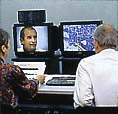 (1)
Video conferences allow rapid international information exchange. |
|
Before the planning of studies in humans is begun, the results
already obtained are reassessed in order to ensure that all possible
risks have been ruled out. (1) |
|
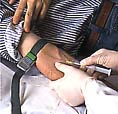 (2)
A volunteer receiving an injection in the arm.
|
|
The new medicine is first given to healthy volunteers. (2)
These are often researchers who have been involved in its development. |
|
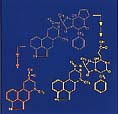 (3)
Stages in the decomposition of the medicine in the body. |
|
The main focus at this stage is on safety but the studies are
also used to investigate the route taken by the medicine inside
the body and the way in which it is decomposed. (3)
If necessary the composition is changed and the dosage form improved. |
|
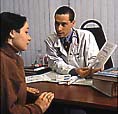 (4)
Physician informing patient about trial drug.
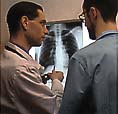 (5)
Physicians studying an X-ray.
|
|
The next step is to administer the medicine to specially chosen
and fully informed patients who are actually suffering from the
disease in question.(4)
The focus now is on determining the medicine's efficacy and finding
the ideal dosage. Specialist physicians and Novartis researchers
evaluate the results together. (5)
|
|

(6 / 7)
Physicians and hospitals around the world test the new drug. |
|
If initial results in patients are favourable further confirmatory
studies are carried out in larger patient groups. Hospitals and
physicians all over the world cooperate to ensure that the widest
possible variety of cases and outcomes is studied. (6 / 7)
Clinical studies are expensive and time-consuming requiring several
years until completion. There is no guarantee of success at the
end: on average only one in five medicines survives the clinical
testing phase.
|