|
|
|
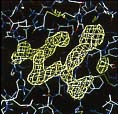 (1)
Molecular structure represented on a computer screen (X-ray structural
analysis). |
|
Researchers investigating the causes of a disease have to penetrate
deeper and deeper into the world of bio-molecules in order to
gain an understanding of the particular biological process and
the chemical substances involved. Their ultimate aim is to identify
the mechanism and structure of the "molecular locks" that must
be opened if they are to gain access to the individual elements
of the process. (1) |
|
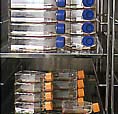 (2)
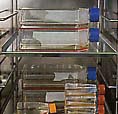 (3)
Living cell cultures in incubator. |
|
Research into both normal and disturbed biological processes is
carried out using special investigational models such as cells grown outside the body (2 + 3), isolated organs or animals. They can also be organisms that have been genetically modified in such a way that they imitate certain features of the process under investigation. |
|
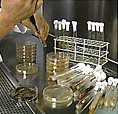 (4)
Stage in the processing of fungi to obtain an active substance. |
|
If the compound occurs naturally -- in a plant, for example --
it can sometimes be obtained directly from that source. (4) |
|
 (5)
Molecular modelling: computerized representation and processing of molecules. |
|
Once the "molecular lock" has been identified, sophisticated computer
programmes are used to help find the active ingredient that will
serve as the key. (5) |
|
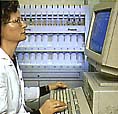 (6)
Computerized peptide production plant.
|
|
Some compounds, such as peptides, which are components of protein
molecules, are manufactured in computerized production plants
(6), while others are produced chemically by synthesis.
|
|
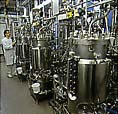 (7)
Pilot plant for production of active ingredients using micro-organisms. |
|
Finally, the role of genetic engineering is of increasing importance
in this area as well: micro-organisms are genetically programmed
so that they can produce the required compound. (7) |