|
|
|
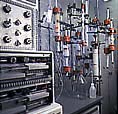 (2)
Separation/purification of substances by chromatography.
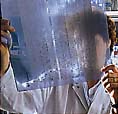 (4)
Evaluation of a film bearing a genetic sequence. |
|
During production of the active ingredient impurities frequently
arise. It is therefore necessary to develop processes and methods
for purifying the substance, and ensuring and controlling purity.
(2)
One way of doing this is to check the sequence of genetic components.
(4) |
|
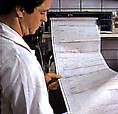 (6)
Checking a substance analysis (gas chromatography). |
|
The active ingredient's mechanism of action is studied in detail,
initially using specially cultured cells and micro-organisms.
These investigations can also reveal undesirable or even harmful
effects on the organism. (6)
These will rule out use of the compound in a medicine, with the
result that all the work already done has been in vain. |
|
 (7)
The compound is patented. |
|
Only around twelve in every ten thousand compounds tested show real promise. Such compounds are patented (7), giving the company the exclusive right to profit from the results of its expensive research efforts.
In most countries patent protection lasts for 20 years, although at least half this time can easily pass before a medicine actually reaches the market. This is because the development process still has a long way to go, with important questions remaining open. |
|
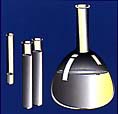 (5)
How can the compound be produced in large quantities?
 (1 / 3)
Torso showing site of disease. |
|
For example, the researchers still do not know whether the compound, which so far has only been produced in small quantities in the laboratory, can be manufactured on a sufficiently large scale (5), nor how it can be made to reach the right part of the body in the right amount at the right time. (1 / 3) |